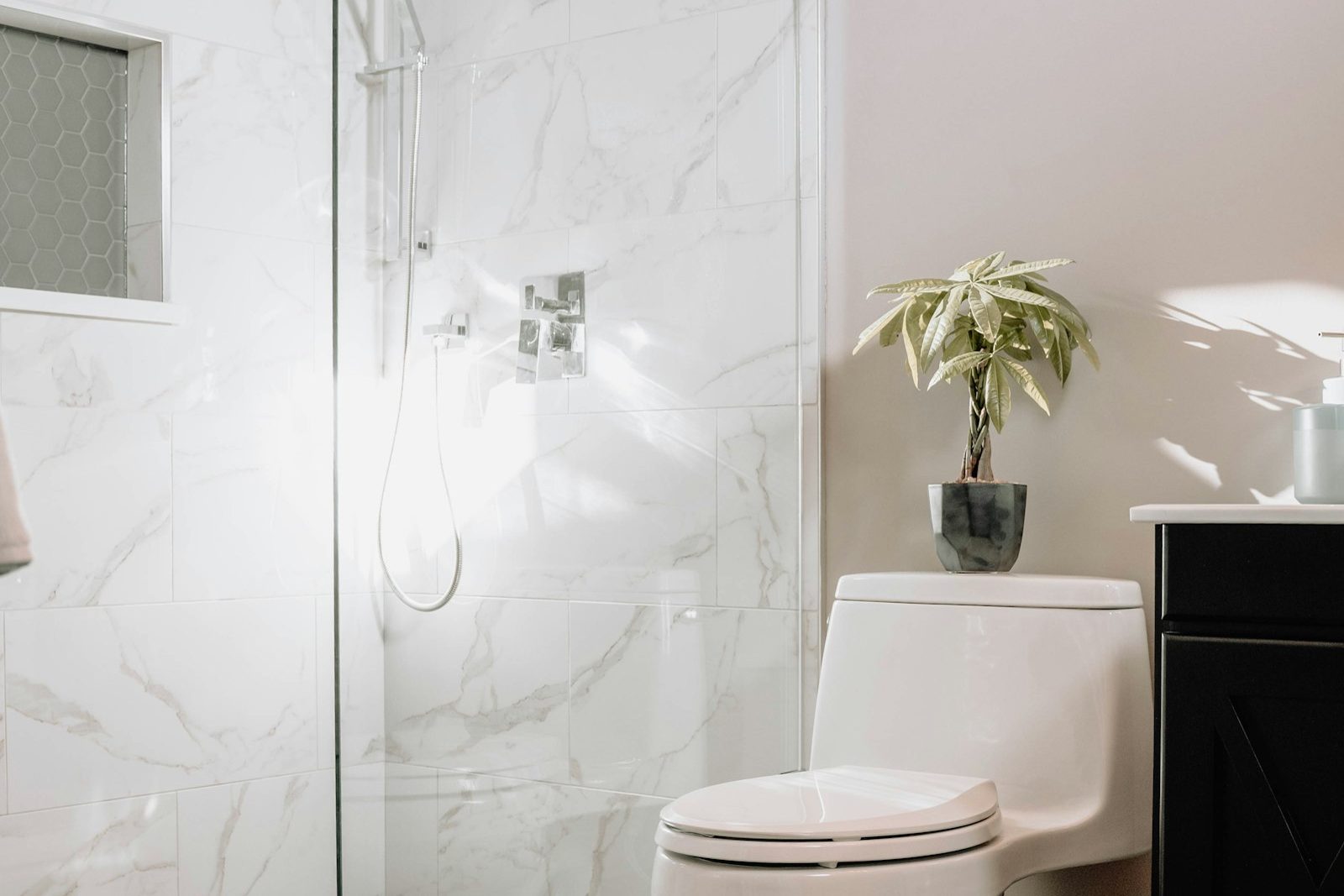
The screen shapes the whole bathroom
A shower screen is one of the largest elements in a bathroom. It defines the shower, contains water, affects how light moves through the room and has a big influence on style. Choosing between frameless, semi-frameless and framed screens is one of the most common questions at our design consultations in Drouin. Each option has strengths, and the right choice depends on the layout, the floor construction, the household and the look you want.
Framed screens
What they are
Framed screens have aluminium frames around all edges of the glass panels and doors. The glass is usually thinner, around 4 to 6 mm, because the frame provides support. Doors may be pivot, hinged or sliding.
Strengths
- The frame provides rigidity and strong water containment.
- Sliding doors suit narrow bathrooms where a swinging door would clash with the vanity or toilet.
- Modern slim frames in matt black, brushed brass or gunmetal create a stylish grid look that suits farmhouse, industrial and heritage interiors.
Considerations
- Frames and tracks collect soap scum, water and grime, so cleaning takes more effort.
- Older-style framed screens can look dated.
- Seals and rollers may need replacing over time.
Semi-frameless screens
What they are
Semi-frameless screens use thicker glass, typically 6 to 8 mm, with frames or channels along some edges, often the wall and floor, while the door and top edges remain frameless.
Strengths
- A cleaner look than fully framed screens.
- Good water containment along the floor channel.
- Often suitable for showers with hobs or where walls are not perfectly square, because the wall channel can absorb small variations.
Considerations
- Channels still collect some grime.
- The look sits between traditional and contemporary.
Frameless screens
What they are
Frameless screens use thick toughened glass, typically 10 mm, held by minimal hardware: hinges, clamps, brackets and sometimes a slim wall or floor channel. There is no frame around the glass edges.
Strengths
- Clean, open and contemporary appearance.
- Makes the bathroom feel larger and brighter.
- Easier to clean, with fewer tracks and corners.
- Shows off feature tiles behind the glass.
Considerations
- Water containment depends on accurate floor falls and careful design, because there are small gaps at hinge edges and beneath doors.
- Heavier glass needs solid wall framing or reinforcement.
- Requires precise measuring after tiling.
- Hardware quality is critical, because hinges carry the full weight of the door.
Fixed panels for walk-in showers
Many walk-in showers use a single fixed frameless panel with no door. This is the simplest and cleanest option, but it requires a shower long enough to keep water inside. Panels are held by a wall channel or clamps and stabilised with a bar to the wall or ceiling. Floor-to-ceiling panels give extra protection in shorter showers.
Door types
- Hinged doors: swing outward, and sometimes inward as well. Need clear space in front of the shower.
- Pivot doors: rotate on top and bottom pivots, often in framed or semi-frameless screens.
- Sliding doors: move along a track or roller, ideal where space for a swinging door is limited. Frameless sliding systems use rollers on a top rail.
- Bi-fold doors: fold in half, useful in tight spaces and some accessible bathrooms.
Water containment and floor falls
Every screen relies on the floor beneath it. The shower floor must fall correctly to the waste so water drains away before it can reach the screen line. With frameless screens, there is no frame to block water at the base of the door, so falls, waste position and shower head placement matter even more. A linear drain at the screen line or at the back wall can improve performance. Seals along the base of doors and between panels reduce leakage.
Under AS 3740, waterproofing extents depend on the shower configuration, including whether there is a screen, a hob or a step-down. Frameless and walk-in showers often need larger waterproofed areas. Every shower we build is waterproofed to AS 3740.
Timber floors and movement
In homes on stumps around Drouin, Jindivick, Drouin South and Buln Buln, timber floors can move slightly with seasons and loads. Heavy frameless glass fixed rigidly to a floor that moves may place stress on hardware and seals. Careful floor stiffening, suitable fixing methods and quality hardware avoid problems. In some cases, a semi-frameless screen with a wall channel gives more tolerance. We assess the floor during the consultation and recommend accordingly.
Hard water and glass care
Rainwater from tanks is generally soft, but bore water and some town supplies can leave spots and scale on glass. Frameless glass shows marks clearly because there is so much of it. Options include:
- A factory-applied or after-market glass coating that repels water
- Squeegeeing after each shower
- Low-iron or tinted glass, which can disguise spotting
- Fluted or textured glass
Glass types
- Clear toughened glass: standard and versatile.
- Low-iron glass: extra clear, without the green edge tint of standard glass, showing tiles in true colour.
- Tinted glass: grey or bronze for a moody, premium look.
- Fluted or reeded glass: adds texture and privacy.
- Frosted or sandblasted glass: full or partial privacy.
All shower screen glass must be toughened safety glass meeting Australian standards.
Hardware finishes
Hinges, clamps, handles and channels come in chrome, brushed nickel, matt black, brushed brass, gunmetal and other finishes. Match hardware to tapware and accessories for a cohesive look. Quality hardware with stainless steel internals resists corrosion and sagging over time.
Safety considerations
- Toughened safety glass is essential.
- Handles should be easy to grip with wet hands.
- Doors should open outward or both ways, so a person who falls inside the shower can be reached.
- For accessible bathrooms, wide openings and step-free floors matter more than screen type.
Choosing for your bathroom
Small bathrooms
Frameless fixed panels or sliding frameless doors keep small rooms open and bright. In tight spaces, a hinged door may clash with the toilet or vanity, so sliding or bi-fold doors may suit better.
Family bathrooms
Frameless or semi-frameless screens with good seals and a well-placed shower head give a clean look and good containment. Easy cleaning matters in busy homes.
Heritage and farmhouse homes
Slim framed screens in black or brass suit period homes and create a crafted look.
Accessible bathrooms
Walk-in showers with a fixed panel, a wide opening and a level floor are usually best. Where a door is needed, outward-opening or bi-fold doors give access.
Measuring and installation
Frameless and semi-frameless screens are measured after tiling, because accuracy is critical. Glass is then made to order, which typically takes some time, so the bathroom may be finished except for the screen for a short period. Installers check walls for plumb, position hardware into solid framing and apply silicone neatly. Allow the silicone to cure before using the shower.
Maintenance
- Squeegee glass after use.
- Clean with mild, non-abrasive products.
- Check and replace seals when they harden or split.
- Tighten hardware if doors begin to drop.
- Replace silicone that becomes mouldy or lifts.
Common mistakes
- Choosing frameless glass for a shower that is too short for open entry
- Installing a heavy frameless door on a wall without solid backing
- Ignoring floor falls toward the screen line
- Mismatched hardware finishes
- No coating in a home with hard or bore water
Replacing a screen without a full renovation
Sometimes the tiles and waterproofing are sound and only the screen is tired: a cloudy framed screen with corroded tracks, a pivot door that no longer closes or seals that have perished. In these cases, replacing just the screen can refresh the bathroom. Before doing so, it is worth checking the shower for signs of hidden leaks, such as loose tiles, cracked grout along the base or staining outside the shower. Installing new glass over a failing shower only hides the problem. If the shower base or membrane is suspect, it is better to address the waterproofing first.
When a hob is removed to create a flush entry, the screen choice changes too, because the floor must be regraded and waterproofed again. That usually becomes a shower conversion rather than a simple screen replacement.
Privacy and light
In bathrooms shared by family members, privacy can matter as much as looks. A partially frosted band at body height, or fluted glass, gives privacy while keeping the room bright. In ensuites open to the bedroom, tinted or fluted glass softens the view and still shows off the space.
Our approach
At a design consultation, we look at your shower size, floor construction, water supply and how the household uses the room, then recommend the screen style that balances appearance, water containment and ease of care. We plan wall reinforcement during framing, set floor falls to suit the screen and coordinate measuring and installation after tiling, so the finished shower looks sharp and keeps water where it belongs.
Framing and reinforcement
Heavy frameless glass doors must be fixed into solid structure. In timber-framed walls, extra noggins or plywood reinforcement are installed during framing at hinge and clamp positions. In masonry walls, suitable anchors are used. Planning these positions early, before linings and waterproofing, avoids weak fixings and ensures hardware does not penetrate the membrane in vulnerable places. Every fixing through tiles and membrane must be sealed correctly.
Cleaning and maintaining glass
All shower glass needs regular care to stay clear. A squeegee after each shower removes most water before it can dry into spots. Weekly cleaning with a mild, non-abrasive cleaner prevents soap scum from building up. Some screens come with factory-applied glass coatings that help water bead and run off; these reduce cleaning but still need gentle care to last. Avoid abrasive pads and harsh chemicals that can damage coatings, seals and hardware finishes. Check hinges, clamps and seals periodically, and tighten or replace them if the door begins to sag or leak. Hard water from some bores leaves stubborn marks, so filtration or a coated glass can be worthwhile.
Matching hardware to tapware
Hinges, clamps and handles come in chrome, brushed nickel, matte black and brushed brass. Matching them to your tapware creates a cohesive look, while a contrasting finish can make the screen a deliberate design feature.
Whichever style you choose, ask for the glass thickness, hardware finish and seal details in writing, so the installed screen matches what you approved at the design stage.
Shower screens and bathtubs
Over-bath screens are a simpler alternative to a full shower curtain where a bath must stay. A fixed frameless panel or a hinged bath screen keeps water in while leaving the bath easy to use. Correct sealing along the bath edge is essential.
Our bathroom services
- Accessible Bathrooms
- Bathroom Design
- Bathroom Renovations
- Bathroom Tiling
- Ensuite Renovations
- Freestanding Baths
- Laundry Renovations
- Leaking Shower Repairs
- Shower Conversions
- Small Bathroom Renovations
- Vanities and Storage
- Waterproofing
Book a design consultation
Tell us about your bathroom and we will visit to measure, talk through ideas and prepare a clear written scope for your home.
Book a design consultation